PSC ASSOCIATE TRAINING PROGRAM
Grow into the clinician you want to become.
Becoming an independently licensed therapist involves more than accumulating supervised hours.
PSC's Associate Training Program is designed to give developing clinicians structured supervision, real-world experience, professional community, and room to develop their own clinical identity.

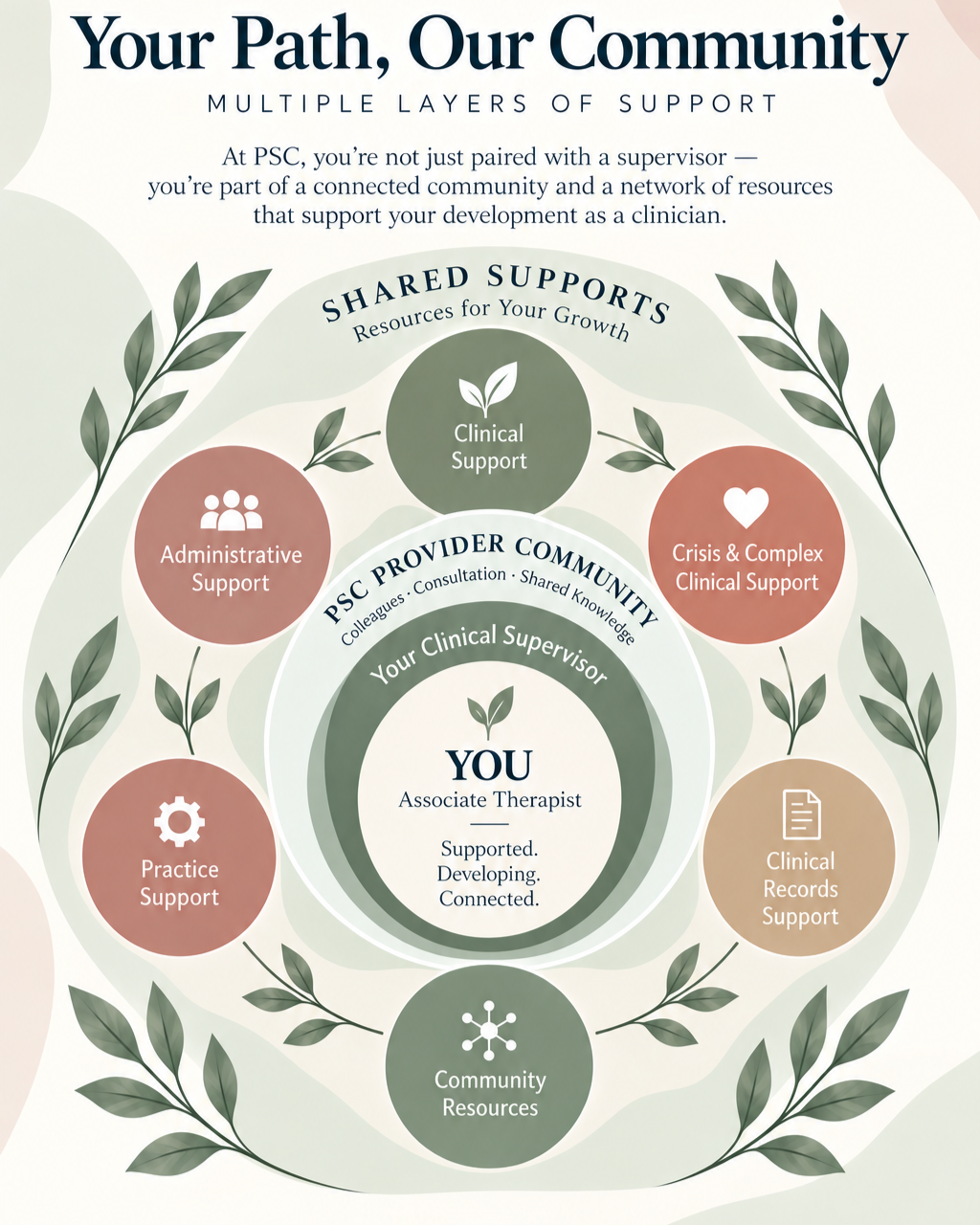
Your supervisor is one part of your support system.
Every associate works with a designated Clinical Supervisor who provides supervision toward independent licensure. But your support at PSC doesn't stop with your supervisor.
Associates are members of the larger PSC provider community, with access to shared clinical resources, specialized supports, administrative infrastructure, consultation, and colleagues with a wide range of experience.
Supervision without another layer of management.
PSC Clinical Supervisors are practicing therapists who take on supervision as an additional role within the Associate Training Program.
Your supervisor's role is focused on your clinical development, ethical practice, licensure requirements, and growth as a therapist. Clinical Supervisors don't serve as managers of the broader provider community.
Supervision supports:
Clinical conceptualization · Ethical decision-making · Documentation · Risk and safety · Professional identity · Boundaries · Countertransference · Licensure development
Meet Our Clinical Supervisors
-
![]()
Alisa Karmel, PsyD, LPC
-
![]()
Camille Alenduff, LCSW, CADC I
-
![]()
Karen Dimalanta, PhD
-
![]()
Matt Lauzon, LCSW, CADC I
-
![]()
Tressa Ernst, LCSW




Learning happens in community.
Some of the most important professional development happens outside a scheduled supervision hour—in consultation, asking a colleague a question, learning from another discipline, attending training, trying something new, and talking through the work with people you trust.
Consultation:
Associates can bring questions to colleagues with different clinical experiences and perspectives. Consultation offers another way to think through the work together, alongside formal supervision.
Continuing Education:
PSC supports ongoing learning through training opportunities and continuing education benefits. Associates can deepen their current interests while discovering new areas of practice.
Shared Clinical Resources:
Associates have access to clinical tools, documentation guidance, and other resources shared across the practice, so they can draw on the knowledge PSC has built together.
Peer Community:
Staff meetings, group supervision, and everyday conversations create opportunities to learn from one another, share challenges, and feel connected in the work.
There isn't one right way to become a therapist.
Associates come to PSC with different interests, experiences, identities, theoretical orientations, and ideas about the clinicians they hope to become.
Our goal isn't to produce clinicians who all practice the same way. It's to help you develop sound clinical judgment, practice ethically, understand your strengths, continue learning, and build a professional identity that feels authentic to you.
The practical side of the program.
-
Applicants must hold a master’s degree in counseling, social work, marriage and family therapy, or a related field. They must also be currently registered, or eligible to register, as an associate with the Oregon board that oversees their profession: the Board of Licensed Social Workers or the Board of Licensed Professional Counselors and Therapists.
-
Each associate therapist is paired with a clinical supervisor and receives individual supervision that meets or exceeds the requirements of their Oregon licensing board. Associates also participate in monthly group supervision in addition to their required individual supervision hours. These spaces offer time to discuss clinical work, strengthen skills, navigate complex situations, and support progress toward licensure.
-
Associate therapists are salaried, with a minimum caseload target of 15 service units per week. For caseload planning, a one-hour therapy session counts as one service unit.
Your salary also covers time for documentation, consultation, care coordination, the required weekly staff meeting, and clinical supervision. At the end of each quarter, associates who exceed their quarterly service unit target may choose a payout for the extra units or roll them over.
-
PSC works with each associate therapist to develop a schedule and work location arrangement that supports their clinical work and life outside of work. Associates may have less flexibility than licensed providers while they build their caseloads and meet supervision requirements. Within those needs, we’ll work together to identify suitable workdays, hours, and in-person, remote, or hybrid arrangements.
-
Associate therapists are full-time, exempt W-2 employees of PSC.
-
Associate therapists are expected to provide thoughtful, ethical client care while actively developing their clinical skills. This includes participating in individual and group supervision, attending required staff meetings, completing documentation on time, collaborating with colleagues on client care, and working toward the requirements for independent licensure.
We also encourage associates to bring questions, reflect on their work, and explore the clinical interests and career paths that matter to them. The program is a place to learn and grow, with support along the way.
-
PSC offers eligible employees benefits that support their health, financial security, and professional growth. Benefits available to associate therapists include:
Medical, dental, and vision insurance
Employee Assistance Program (EAP)
Flexible Spending Account (FSA)
Retirement benefits
Life, accidental death and dismemberment (AD&D), and short-term and long-term disability insurance
Malpractice insurance
Continuing education support
Transportation and Eligible Expense (T&EE) reimbursement
Access to a HIPAA-compliant AI clinical tool
Paid time off
Eligibility and coverage details vary by benefit.
-
PSC’s Associate Therapist Program is designed to support your growth toward independent licensure while giving you room to explore the kind of career you want to build. Associate positions are intended to last up to two years or until you become licensed, whichever comes first.
Completing the program does not guarantee a licensed provider position at PSC. If a position is available, you are welcome to apply. We hope you’ll leave the program with stronger clinical skills and a clearer sense of your next step, whether that’s at PSC or elsewhere. There is no expectation that you commit to staying with PSC after licensure.
The goal isn't simply licensure. It's finding your path.
Associate therapists are part of the PSC community from the beginning—as clinicians, colleagues, and people whose perspectives shape our work together. As you grow toward licensure, we want you to have space to explore your interests and decide what kind of career feels right for you.


You might hope to continue in a group practice, pursue a specialty, or eventually build a practice of your own. Our goal is to support your development and help you prepare for the direction you choose.
Could PSC be part of your next chapter?
If the Associate Therapist Program feels like a good fit, we’d love to hear from you. Email your résumé and a brief note about your clinical interests and what draws you to PSC. We’ll let you know whether we’re currently considering associate applicants.